All horses in the game have genetics that determine how successful they will be in chosen disciplines.
There are 6 main conformation areas:
- Head
- Neck
- Frame
- Hindlegs
- Forelegs
- Shoulder
Each of these conformation areas consists of 4 allele pairs, with 2 pairs dedicated to Jumping and 2 pairs dedicated to Dressage.
Basic Genetics
The genetics in this game are all based on Punnett square matching. As previously mentioned, conformation genes (and the other genes) come in allele pairs, for example Aa. Capital letters represent dominant alleles, which are superior to lowercase letters, representing recessive alleles. In this game, you want to maximize dominant alleles!
When a foal is born, the game automatically calculates its genetic outcome using a Punnett Square. Say, for example, we have a sire who is Aa in a particular gene, bred to a mare who is Aa in the same gene. Their resulting Punnett Square would look like this:
| A | a | |
| A | AA | Aa |
| a | Aa | aa |
As you can see, after matching the sire and dam, there are three possible outcomes for the foal: AA, Aa and aa, with Aa being the most likely because it appears twice. Now imagine this replicated over the roughly 30 genes that each horse in OTO has, and you have a pretty good idea of how complex breeding in this game is!
Revealing Genes
You can get an idea of what your horse's genetics might be by entering them in an inspection or riding test. After the inspection or riding test is complete, a score card will appear on the horse's page under Inspections. See Inspections and Riding Tests for more details on how to interpret these score cards.
Advanced Genetics
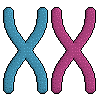
While the Punnett Square above is the basis for OTO's genetics, we also have added some extra complexity in order to make things more interesting! Each conformation area (e.g. Head, Neck, etc) are represented by a chromosome in OTO. In the gametogenic cells of the body, the ones that produce sperm and eggs (gametes), the genetic material is stored in long chains called chromosomes. Each of these chromosomes contains the genetic information for that animal, and they receive one chromosome from their sire and one chromosome from their dam. For example, when we say a horse is "Aa", we mean that on one of its chromosomes it has an "A" allele for a particular gene, and an "a" allele on the other chromosome. The first step in producing a gamete is chromosomal replication, where the long chains duplicate themselves, making an identical copy of their information. These copies are called "sister chromatids" and they become attached in the middle to form an X:
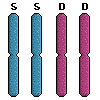
Chromosomes of the same "type" (i.e. all the Head chromosomes) line up together, allowing for crossover to occur. For the sake of easier interpretation, in the photos the chromatids have been separated in the depictions. Remember that there is one set of chromatids (with the same genetic information) from the sire, and one set of chromatids from the dam. For example, if the sire contributed an "A", both of the chromatids from the sire will have an "A".
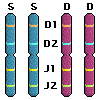
The genes on each chromatid are located on things called loci, which are found on the "arms" of these chromatids. These are basically locations on the chromatid arm where genes live. In OTO, each chromatid has 4 known loci, each one corresponding to one of the genes for that conformation area, i.e. the 4 allele pairs for Head, with 2 dedicated to dressage and 2 dedicated to jumping. The jumping and dressage genes appear on the same arm of the chromatid, just for convenience. A visual representation of this:
Once the chromosomes are lined up, there is potential for crossover to occur between neighbouring chromatids:
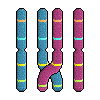
Once the chromatids separate, they take pieces from each other, including the genes on those pieces. This allows for "recombinants". In this case, the J2 allele that was formerly on one of the dam's chromatid is now on the sire's chromatid, and vice versa:
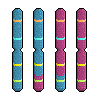
Crossover adds to the genetic variation possible when an animal produces gametes. Without crossover, the only possible options for a genetic cross are the ones supplied by the parents. Let us use a foal who is "Aa Bb" for jumping as an example, where "AB" came from his sire, and "ab" came from his dam. With no crossover, the only options he has to pass onto his foals are either the "AB" chromatid, or the "ab" chromatid. However, with crossover on the jumping-focused chromatid arm, it is now possible for him to pass on "Ab" or "aB" for jumping. This same crossover process may be repeated on the dressage-focused chromatid arm as well, to allow for more variation there. This makes the Punnett Square for jumping much more complicated:
| AB | ab | Ab | aB | |
| AB | AA BB | Aa Bb | AA Bb | Aa BB |
| ab | Aa Bb | aa bb | Aa bb | aa Bb |
| Ab | AA Bb | Aa bb | AA bb | Aa Bb |
| aB | Aa BB | aa Bb | Aa Bb | aa BB |
Crossover can occur at any point along a chromatid's arm, so when you have two loci on the same arm, there is a potential for those loci to crossover together. How often two genes are separated due to crossover depends on how far apart those two genes are on the chromatid arm. If they are close together, then they are more likely do be transferred together, if they are far apart, they are less likely to be transferred together. In the case of transfer of both loci on an arm at the same time, this adds more variation between the dressage and jumping genes. Say the above foal was "Cc Dd" for dressage, as well as being "Aa Bb" for jumping. As above, the "AB CD" came from his sire, and the "ab cd" came from his dam. If there is a full crossover of one of the arms, suddenly "AB cd" and "ab CD" become possible chromatid options that this foal could pass on.
After crossover occurs, the cell divides taking one of each chromosome pair with it, and thus the genetic information carried by that chromosome. Remember that the chromosomes are still an X shape at this point, and if crossover occurs, only one of the chromatids on each chromosome is involved. Using the example above, this means that at this point, there is one chromosome in the pair where one chromatid is "AB CD" and the other is "AB cd", and the corresponding chromosome is "ab CD"/"ab cd". Now, these two chromosomes are separated into their own primary spermatocyte or oocyte.
Once they are divided into a primary cell, they undergo another division where each chromatid is pulled apart and joins its own cell. These cells become the sperm or egg that is produced by that animal, and they only contain one chromatid from each chromosome. For the horse above with crossover, this means his potential sperm chromatid options are "AB CD", AB cd", "ab CD" and "ab cd", which is twice as many options as there would have been without crossover! Having increased variations helps make the game more difficult, as you never know when a crossover will pop up!
Advanced Genetics Explanation Video